
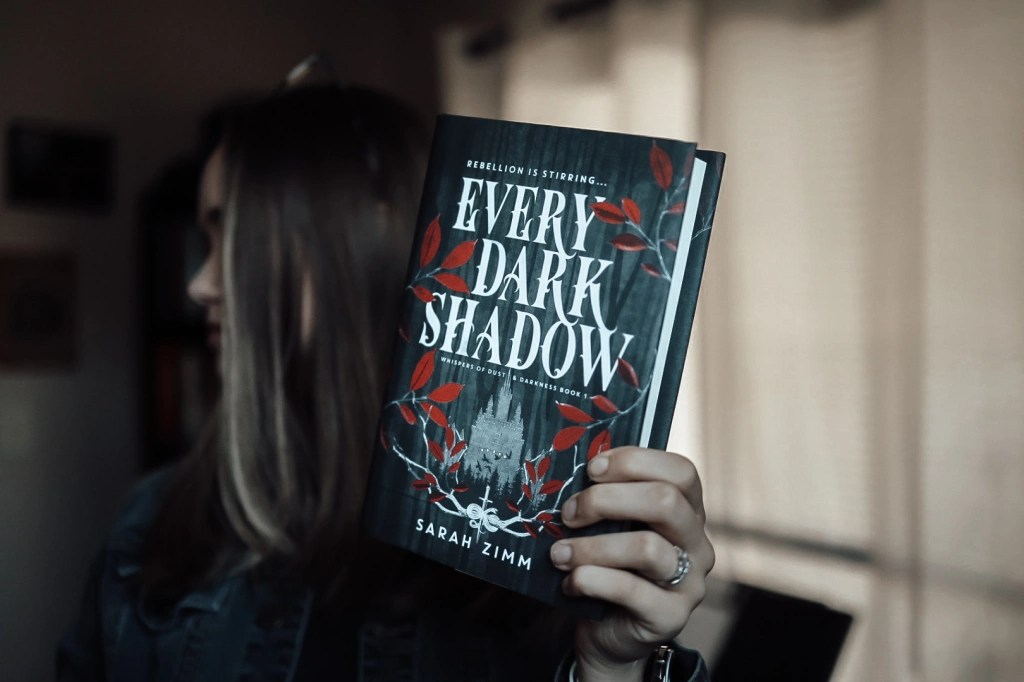
My good friend Sarah Zimm’s debut novel Every Dark Shadow hit shelves just two weeks ago, but has already been met with plenty of five-star reviews and excitement. Today’s article shares her insights and reflections on the experience.
Some of the very best moments of being a writer come when we hold published work in our hands. I was privileged enough to be a beta reader and then an ARC reader for Sarah’s brilliant debut novel, Every Dark Shadow, which hit shelves on August 29, 2023. Check out the synopsis:
Orphan turned fugitive Ophelia Dannan has been safely hidden in the mortal world for four years, her memories and magic locked away from herself and the siphoning Gray King of Magus. A king whose armies hunt relentlessly for one source of pure magic that vanished with Ophelia.
A scholar, a smugger and a soldier have sworn their lives to hide and guard her until the time is right to awaken her magic. To protect her, they move her often and see to it Ophelia forgets the lives she lives with them. Rune chooses quiet farmsteads, filling Ophelia’s time with adventure and daydreams. Falcon prefers the grit of city streets ruled by gangs, challenging Ophelia to survive by wielding knives and swindling thieves. And Hart has all but given up his rotation with her, after what happened a year ago, to keep safe the girl he fears could destroy two worlds.
But across worlds in a kingdom as dark and brutal as it is beautiful, where the Gray King enslaves the magic born, rebellion is stirring and a dark force is rising to stake its own claim on the throne. When shadows reach tendrils across the mortal world for Ophelia, she’s pushed into a perilous quest in search of truth, her magic, and a way to break the monarchy before it breaks them all.
—Every Dark Shadow by Sarah Zimm (Released August 29, 2023)
The stunning cover (designed by Sarah Hansen at @okaycreationssh), captivating synopsis and beautiful prose speak for themselves, but I was lucky enough to have the chance to visit with Sarah and learn more about her experience behind the scenes while writing, editing, and publishing EDS. Buckle in for this deep dive.
There are two books on your author website. What inspired you to write fantasy, and why did you choose to debut with Every Dark Shadow?
“I think that I found myself more and more as I continued writing. I’ve been writing over the years and finally committed to finishing a book. I kept gravitating toward paranormal or working in some sort of speculative element or magic, and then I noticed as I was shifting and maturing in my own craft that it was fantasy. I felt like I found my genre, I found my niche. That’s where my mind goes.
I don’t tend to write simply. I’m not great at writing humorous or comedic romance contemporary stuff. It’s a lot of playing to your strengths as an author. I really like complex genres, with complex worldbuilding, layered plots, twists, that kind of stuff. Fantasy is really great for that—you can lose yourself in that kind of stuff.
The reason I debuted with Every Dark Shadow . . . I had written Wicked Glimpses when I was first starting out and teaching myself how to finish a book, how to write a fantasy book that was that complicated, how to build an entire world and invent everything. That was the book that made me fall in love with reading, and I fell in love with those characters so it was really hard for me to set them on the shelf. But I feel like at the same time, this story came, this was something I felt passionate about and I felt like my craft was catching up with the idea. I’d like to go back to Wicked Glimpses and relook at the world.”
Branching off of that and your experience writing, revising, and eventually publishing Every Dark Shadow, are there insights and learning you’re going to take away from it and put back into Wicked Glimpses and your future books?
“Absolutely. I think one of the best things I ever did writing the book was not writing alone. I didn’t just sit down and write the entire book without input along the way. I had a group of three critique partners who I was able to trade pages with in sections as I went. I wrote my very first book Wicked Glimpses in about a year and a half, almost two years, and [Every Dark Shadow] took me eight months to write. And I think part of that is that you’re learning as you go, you’re going to get faster, but the other part is having a team of people who can keep you accountable to keep those deadlines and who can give you feedback so you’re not spinning your wheels and you’re not stuck.”
How did you approach building the magic system in your novel, and what role does magic play in the story?
“It’s always one of those questions. For some people, the magic comes first—for me, it’s always the characters, so the magic came secondary to them. It was a device to help Ophelia reach this transformation, but also to create conflict in the story. It’s almost like a mouthpiece for some of the things that you’d like to explore but you can’t explore as well in contemporary writing because it’s difficult. When you’re writing a completely fictional, completely fantastical world, you’re able to explore themes like oppression, for example, from a different lens. Magic was one of those ways I could explore some of those deeper themes. It started with wanting something that was going to provide enough growth opportunity for my characters, but also be exciting for the reader to read and make sense, and have a purpose, too.
I wanted the worldbuilding to go all the way back to the beginning of the kingdom, like how the magic was so instrumental and how the magic was born. And not just that but how instrumental it was in how life continues. Literally, the forests that exist, the seasons, everything is driven, influenced, and fed by magic. Whether or not you are someone who is of the magic born or a mortal that lives in this world, your life depends on magic. The relationship the people have based on where they are, the haves, the haves-nots, even people of the wealthier class in the world verses people who are commoners, you all rely on it in some way or another but you have a different lens and viewpoint of what magic is to your life. Whether you accept it or reject it or wish it didn’t exist in your life—it was really fun to explore that with the main characters like Hart, for example, who would really rather not have magic, and then of course you have this king who is half-mortal, half-magic born, you have someone on the other spectrum saying they need to control magic, can’t let it run amuck, and then you’ve got people who are all about, “Give me the magic power,” so it’s a really fun way to use that to explore people’s traits and the human nature, too.”
What are some of the central themes in Every Dark Shadow?
“One of the core themes, and the question I was asking myself as I was writing this was, “What does a better world look like?” Even in our lives today, one of the common things we can all say is that we want our world to be better. But how we interpret that is so vastly different depending on our experiences and what we’ve been through in life and what we’re willing to sacrifice and do to see that ‘better’achieved. So that was one of the thematic questions I was exploring. Ophelia doesn’t know what she wants in the beginning so we learn through some of the other characters what they want and what they’re willing to do to see Magus be more than what it is today, being oppressed by this monarch. We can also see what the king is willing to do to achieve what he sees as the best version of this kingdom. Book one is really setting that up and asking the question, “What does better look like?” and book two will be much more focused on “What are you willing to sacrifice now to see that change?””
Is this a planned duology or a series?
“Ophelia’s story is a planned duology, but the great thing about being an indie published author is that you can change your mind. Until the last word is written, I never rule that out. Plot as if, but allow your characters room to tell you when the story needs to grow and go in different directions. I’ve also built in some flexibility with novellas. I’m personally not the biggest fan of spin-off novels that have nothing to do with the central story and the central plot, so anything that I do with novellas in the Whispers of Dust and Darkness, this core story of Ophelia’s, will be directly related to the main plot things that we’ve seen. I do have plans, potentially, for a series that would follow different characters we haven’t met in the universe yet.”
What challenges did you face while world-building, and how did you overcome them?
“The thing with worldbuilding is you start with the bones and the structure, right? Asking what the system needs to accomplish, what makes sense for what you’ve already visualized and where your characters are going. I try to build out in book one, this is what the readers are going to need to know and to share that with readers. What else do I as the author need to know? The background. Because not everything is going to go on the page right away.
Start with the bones of the system. What kind of kingdom is it? I knew that it was going to be a parallel version of New York, so the bones were the same. I knew how magic was going to be feeding life there and how intricately woven everything would be, so forests are really important. I left some flexibility for the forests, like what the experience will be in each one of them and how they provide different sustenance to different communities. What do the roles of people look like in trying to cultivate? What does trade look like across the kingdom? Because there are different regions and different jobs that people have.
It’s also thinking about what if I were someone like a wealthy Crat (we call them Crats, but aristocratic mortals in the book)? What if I were to live in Cirque, where it’s much more living in the city, high society, and they have magic? What’s that daily life like compared to somebody in a commoner community who doesn’t have magic? And they have to do lots of their own farming and growing and that kind of thing. What’s it like for someone who has magic and your children are taken to serve the kingdom at the Academy? What does that leave the parents like? What about the people with magic serving the kingdom directly? What’s their life like? Really just thinking about who these people are and building a world around them.
The world really does evolve as you grow and as you figure out what the story really needs. Sometimes you’ll get all the way to the third act before you realize that they’re going to need something like water coming from trees. Writing happens in so many layers and worldbuilding is the same. I think you get the bones and you start to put together all the things that make it real as you go.”
1800s New York was clearly a major influence on parts of this story. Were there other cultural influences or real-life inspirations that shaped your fantasy world?
“Yes, I read a lot of fantasy. Some of the really popular fantasy today has fae or witches, and I do like those books. I think I was just, at the time, looking for something that felt a bit more grounded and tangible. Not contemporary fantasy or urban fantasy but almost like . . . the “as if?” So that you really felt grounded in a world that was familiar but the magic really felt like it could be possible.
New York in the 1800s—I wanted this unrefined grit, this time period, especially when women were just starting to demand more opportunities. Women were starting to work and, like Ophelia, they didn’t want to wither away on a farm. ‘I want to see the world. I want to be educated. I want to work.’ Even if that work was in terrible conditions. I really liked that time period and took a lot of inspiration as far as the carriages and thinking through who would drive horse-drawn carriages versus who would drive carriages in the magic world where you’d still see some of that, except the carriages are fueled by magic.
Some of the more enchanting pieces evolved in contrast. I wanted this world to feel like a place you could come into and Ophelia would see the beauty but then see how that beauty was being drained from the kingdom by this king. Seeing what’s possible and what it could be and then seeing that she might be able to do something about it.”
Describe the journey of your protagonist from the beginning of the story to the end. How do they evolve?
“I intentionally wrote Ophelia not knowing everything about her when I first started (I know a lot more about her now, going through the process). I wanted to discover her as a reader would discover her and that’s really challenging. I’ve never done that before. . . . She’s been a puzzle and I’m still unlocking her, she’s getting louder and louder, it’s great. . .
She’s very much in the dark, in the beginning, and then she ends up being in the light, in a general sense (I won’t spoil it). But she starts out not knowing that she’s living a life essentially like the Truman story where people are watching her. She goes from being this girl who doesn’t really reflect on why her gaze is pulled to the horizon and why she feels this impulse and this itch to keep moving, keep searching for something. Searching for adventure.
As she moves to a different time, a different Keeper, we start to see different sides of her and see how each brings out something new in her, how that surfaces memories as she’s going. It’s this will inside of her that is getting stronger as she’s going through the book. By the time we get her to the magical world where she’s understanding more of what’s going on, it’s her warring with herself. She has this innate fear inside—for some reason she doesn’t understand—that she’s going to hurt people. Whatever people are after her for is something big and strong enough that it could be catastrophic and so that scares her. She’s also very determined to find the truth and to figure out what is going on in Magus.
By the end of the book, she’s gone through these bumps, used what she can do and is seeing some of the consequences of that magic reinforcing some of the things she tells herself. By the end she’s faced with her first choice: what is she going to do to make things different and make things better? And that gives us momentum into book two for what she’s seen now. Let’s see if she can make different choices.”
Tell us about the process of creating the map of your fantasy world. How important is geography to the plot?
“This is a quest story. I knew they would be going to Magus and I wanted them to move around in the kingdom and interact with the different cultures and people there, so it was really important for my own author brain logistics. I have some early sketches where I took the shape of New York and thought about, you know, okay, where are they going to be passaging into from the mortal world? Where’s the proximity to the castle and the king is situated? Thinking about the Belly, for example, the central region that is the safe sanctuary to the magic-born. I needed to orient myself so that I could talk about it and send them on the right paths through the kingdom. Speaking about the differences too, people who are more born and raised in the south where the Academy is, how is that different than those born in the north? We haven’t explored the north very much in book one but that’s an entirely different region.”
The characters in Every Dark Shadow jump through multiple decades in time. What was it like commissioning the character art and trying to decide what they would wear?
“I love art and I love collaborating with artists. I was a little clueless as far as what everyone’s different process was like and what people are inspired by—what does an artist even need when you come to them? As you do on Bookstagram, I’d been looking for artists and found an incredible artist. Her handle is @lesyablackbird. The character artists who have their process down are really great at communicating what they need and make it easy to figure out how to work with them. She took all of my Pinterest inspiration. She’s one of the artists who wants to read the book first, not all of them do. She had Ophelia in mind and I called out a couple of the areas where there were some physical descriptions of what she was wearing in the time period. I just sent her a picture and told her I really loved the lace of the 1800s, there’s little details in the book about it. Not the fanciest dress because in the beginning she’s not part of high-society 1800s New York. And the color has some meaning that you discover as you get into the book.”
Thanks for making the time to talk about your experience today. What advice do you have for aspiring fantasy authors who are working on their first novels?
“Read a lot. Keep note apps and note things by your bed, and just keep asking yourself, “What if? What if this happened?” Take time, five minutes a day and just write the answer to “what if?” You can come up with a lot of great ideas. The biggest one I think is just to remember that books really are written in layers and you really are just shoveling all the sand in the sandbox. It’s going to get molded with feedback. Get that feedback. Don’t be afraid, don’t take it personally, just look at it as an opportunity to make your writing stronger and think about that end product of the book that you want to put out there.”
Follow Sarah on Instagram @authorsarahzimm and grab your copy of Every Dark Shadow through her website, Amazon, Barnes & Noble, Bookshop.org, kobo, or Apple Books.
Hannah L. Ackerman
 Hannah L. Ackerman Portfolio
Leave a comment